Q.01What are black box royalties?+
Black box is an informal industry term for royalty income that has been collected but has not reached the rights holder entitled to it. It is not one accounting category. Depending on the organisation it can mean money that is unmatched to a work, matched but unclaimed, or held back pending a dispute or review. Any investigation should begin by recording the collecting body, rights type, territory, period and the formal status that body actually uses.
Q.02What is the difference between unmatched, unclaimed and suspense royalties?+
They are not synonyms. Unmatched income cannot yet be connected to a musical work or recording. Unclaimed income is linked to a work but no rights holder has claimed the share. Suspense, or hold, is income an organisation is deliberately withholding because of a dispute, a review or a legal question. The Mechanical Licensing Collective reports these as separate categories rather than one pool, and the route to payment differs for each.
Q.03Why do royalties go unpaid when the usage is visible?+
Usage shows that activity happened. Payment needs a documented route from that activity to a party. That route breaks in four common places: registration data submitted to a society is accepted but never resolves to a payable claim; identifiers do not agree, so a recording cannot be linked to the registered work or the credited writer; the territory has no mandate or no eligible claim; or the rights type is administered by an organisation nobody has registered with. The UK industry agreement on music streaming metadata states plainly that incomplete or inaccurate metadata can delay or prevent accurate payment.
Q.04What is BlackBox Royalty Investigator?+
BlackBox Royalty Investigator is a forensic royalty investigation platform for publishers, songwriters, estates, catalogue funds and rights teams. It takes a real catalogue and the official records that describe it, tests where the documented route to payment breaks, and produces an evidence pack with recorded provenance and accountable human review. It investigates and documents. It does not file claims and does not replace a society, an administrator or an adviser.
Q.05How is it different from royalty accounting or administration software?+
Royalty accounting and administration systems hold and process the operational record: registrations, statements, splits and payments as they are. BlackBox Royalty Investigator works on the gaps between those records. It compares what an administrator holds with official registration and usage evidence, classifies the conflicts, and prepares a file another organisation can review. The two sit alongside each other rather than replacing each other.
Q.06What does a royalty investigation produce?+
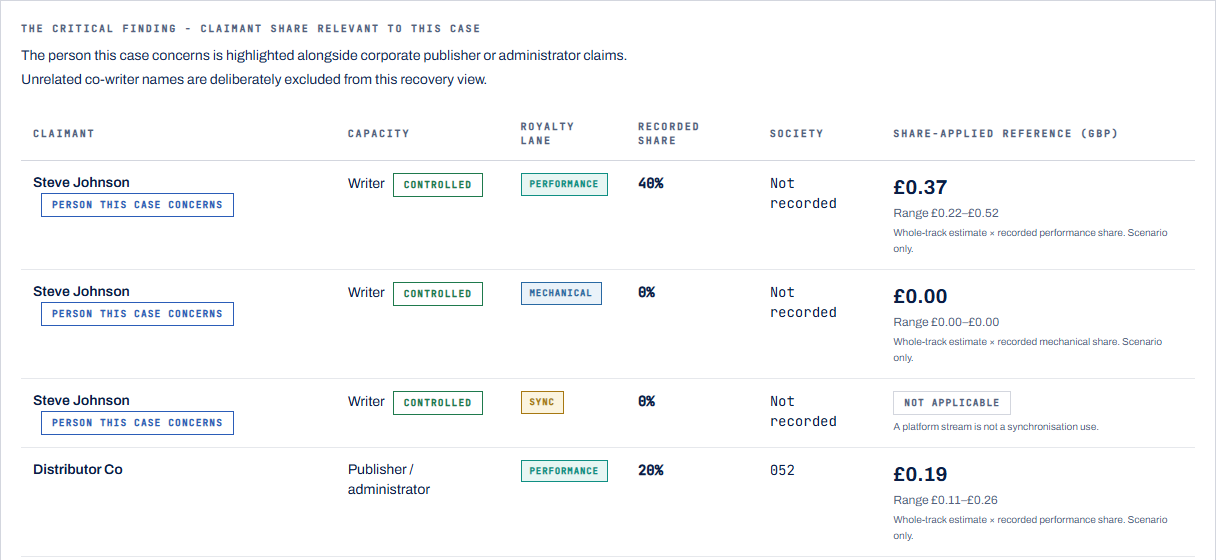
A documented evidence pack. It carries the source records and the date and origin of each one, the identity and work records the finding depends on, the conflicts found and how each was classified, the processing history, the investigator who reviewed it, and clearly labelled possible-value scenarios. Values remain labelled as scenarios until a claim is acknowledged and settled. The pack is built to be read by a rights holder, a recovery team, an instructed adviser or a collecting society.
Q.07Is the investigation record tribunal-grade?+
The investigation record is designed to support tribunal-grade scrutiny when the stated source and custody conditions are met. Where the investigation begins with an official CWR record issued by a PRO or CMO and its receipt is recorded in the chain of custody, the methodology is documented, controlled and reviewable under NDA. Source quality, methodology, processing, investigator judgement and the resulting finding remain open to appropriate challenge. No tribunal or claim outcome is guaranteed.
Q.08Does BlackBox Royalty Investigator file claims or contact societies for me?+
No. It prepares a reviewable evidence base that you or an instructed adviser use for claim preparation, filing and follow-up. Filing routes, deadlines and eligibility rules are specific to the society, territory and rights type, and the decision to pursue a claim stays with the authorised rights holder and their advisers.
Q.09How are engagements scoped, and what does a royalty investigation cost?+
Engagements are B2B and scoped around four things: the catalogue, the processing the investigation question requires, the secure evidence workspace and hosting that must be maintained, and the investigator access the team needs. BlackBox Royalty Investigator is never sold as a percentage of recovered royalties. Pricing is agreed directly with the organisation and no public price card is published.
Q.10Do you take on contested catalogues and estates?+
Yes. Contested writer credits, deceased writers and inherited catalogues, historic publisher acquisitions and catalogues in the middle of a transaction are all common starting points, because those are exactly the situations where the registration record and the commercial reality have drifted apart. Where a matter needs legal representation, we work alongside the instructed firm and prepare evidence for their review.