Connected roster intelligence and artist operations for labels, distributors, management companies and education partners. Musicata Pro links an organisation view with a branded Artist Lab for every active artist in scope.
Human-led forensic royalty investigation for publishers, rights teams, estates and catalogue owners. BlackBox preserves source records, investigator actions and findings in a full chain of custody and produces a reviewable evidence pack.
It does not file claims, decide legal entitlement or guarantee recovery. The client and its advisers decide what action follows.
StreamShield
Roster-wide streaming-integrity monitoring inside Musicata Pro. StreamShield shows where
review should begin and records the factors behind that priority. People decide what happens next.
Connected roster intelligence and artist operations for labels, distributors, management companies and education partners. Musicata Pro links an organisation view with a branded Artist Lab for every active artist in scope.
Human-led forensic royalty investigation for publishers, rights teams, estates and catalogue owners. BlackBox preserves source records, investigator actions and findings in a full chain of custody and produces a reviewable evidence pack.
It does not file claims, decide legal entitlement or guarantee recovery. The client and its advisers decide what action follows.
Streaming fraud monitoring across the whole roster.
StreamShield is the streaming-integrity module inside Musicata Pro. It monitors a
roster for the patterns associated with artificial streaming, playlist manipulation
and manufactured growth, so labels, distributors and management companies have a
documented basis for review before a platform decision lands without context.
It shows where review should begin and why. People decide what happens next.
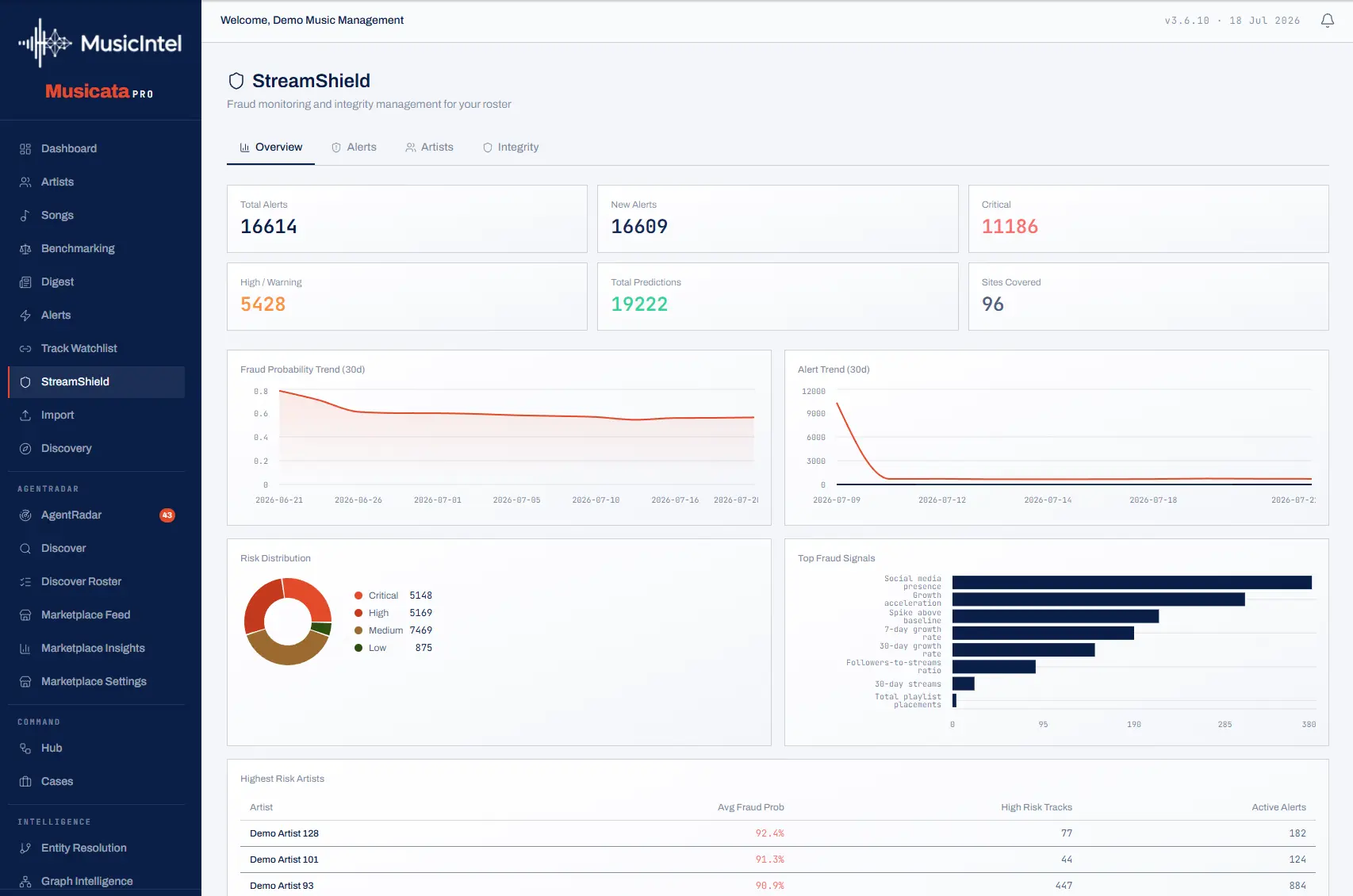
StreamShield · fraud monitoringThe maintained catalogue-wide integrity view - alert trends, risk distribution, and the highest-risk artists ranked.
Scope
Whole roster
Window
Last 30 days
Reading
Four risk bands
Output
Review priorities*
* An indicator is not by itself a final allegation or a platform decision. Enforcement stays with the responsible distributor, platform and rights holder.
- The integrity problem
Artificial streaming does not only distort one artist's numbers. It distorts every decision made on top of them.
Four patterns worth monitoring for
Pattern · 01
Artificial streaming is defined by the absence of genuine listening intent.
A genuine stream reflects a person's genuine listening intent. Spotify uses that
distinction in its public guidance, and the IFPI anti-stream-manipulation code
describes manipulation as activity that does not represent genuine demand. An
inflated count can therefore make an audience look larger or more engaged than the
underlying behaviour supports, and the harm is documented: in March 2026 Michael
Smith pleaded guilty in a United States federal case involving bots, thousands of
accounts, billions of fraudulent streams and more than $8 million in royalties.
Coordinated playlist behaviour is a pattern, not a single number.
Manipulation can be assembled from bot farms, manufactured listeners, coordinated
playlist placement or automated playback scripts. Reading it means looking at
listening patterns, geographic distribution, playlist behaviour and temporal
anomalies together, because each of those on its own has an innocent explanation
available to it.
Bot playlists
Pattern · 03
An ISRC block issued to your distributor can become your exposure.
Distributors batch-issue ISRCs within registration blocks, and the proximity
between those identifiers can be exploited to mask artificial activity across
several catalogue entries at once. Most labels do not know the issuance chain well
enough to recognise the route, so the exposure tends to be inherited rather than
chosen.
ISRC-block fraud
Pattern · 04
A manufactured chart week is built to look plausible, not to look impossible.
Manipulation aimed at a chart-eligible window is assembled from layers that are
each defensible in isolation, and it is the combination that resists an
alternative explanation. That is also why a single anomaly should slow a decision
rather than trigger one: misclassification harms legitimate artists and damages
distributor relationships in the other direction.
Manufactured weeks
The consequences are real. Spotify says it removes confirmed artificial streams from public metrics, may withhold associated royalties and can remove content in some circumstances - and distribution partners may act under their own agreements.
A pattern is not a verdict. It is a reason to look.
Not every unusual pattern is manipulation, and misclassification harms legitimate
artists, damages distributor relationships and creates exposure in the other
direction. StreamShield is built for that reality: it reads the layers together,
ranks where attention is worth spending, and hands the question to a person with the
supporting record attached.
How StreamShield works
Five things happen continuously across the roster. None of them ends in an automatic
decision.
Step · 01
Roster-wide monitoring.
StreamShield monitors the whole roster rather than the artist someone happened
to ask about. Bot-inflation and fraud patterns are tracked across every active
artist in the agreed scope, so the first sight of a problem does not depend on
somebody's hunch.
Every active artist
Step · 02
A probability, and the trend behind it.
The catalogue-wide view carries a fraud probability over the last 30 days
alongside the alert trend, so a team can see whether exposure is building,
holding or receding rather than reading a single day in isolation.
Direction, not a snapshot
Step · 03
A risk band per artist, and the distribution across the roster.
Every monitored artist carries one of four risk bands - critical, high, medium,
low - and the distribution across the roster is the useful number: it tells an
operations team how much of the roster is genuinely in question, and how much is
not, before anyone opens an individual case.
Four risk bands
Step · 04
Highest-risk artists, ranked.
The artists carrying the most risk are ranked so review effort lands where it
matters. This is a work queue for a human team, not an enforcement list.
Review priorities
Step · 05
Contributing factors and investigation notes.
Each case carries the contributing factors behind the risk level and the
investigation notes recorded against it. That gives a label, distributor or
manager an earlier, documented basis for intervention, and a record of what was
asked and when.
Evidence for people
What StreamShield does not do - It does not prove fraud. Indicators are contextual and do not establish manipulation on their own. A low-risk or clean-looking result does not prove that every stream is legitimate. StreamShield does not remove streams, take music down, withhold royalties or issue penalties: enforcement decisions remain with the relevant platform, the responsible distributor and the rights holder.
- Who uses StreamShield
Four teams, one question asked differently.
Labels · distributors · management · education
Audience · 01
Record labels.
Monitor bot-inflation and fraud patterns across the roster before a concern becomes
a platform penalty or a difficult artist conversation. The result supports
investigation and action without pretending that a clean reading guarantees
legitimacy.
See risk earlier across the active roster, before a concern becomes a DSP penalty
or damages the platform relationship. Findings support investigation and responsible review.
Monitor the patterns around the artists you represent. The findings help you ask
better questions before a concern becomes a platform penalty or damages a
commercial relationship.
Institutions add StreamShield to a Musicata Pro teaching environment to work
through evidence, integrity and audience quality with a cohort, using a current
artist record rather than a hypothetical one.
StreamShield is not sold as a standalone monitoring tool. It is one of the
capabilities inside core Musicata Pro,
the B2B roster operating platform for labels, distributors and management
companies, and it reads the same cross-referenced artist record the rest of the
platform works from.
That matters for integrity work specifically. Manufactured activity rarely produces
a supporting trail in adjacent systems at the scale the listening implies, so the
value of a risk reading depends on what else is visible around it.
StreamShieldStreaming-integrity and risk indicators for review.
AgentRadarMomentum and early-discovery indicators across the market.
TourManagerGeographic demand to support live planning.
ReporterStructured reporting and briefings from the shared record.
Artist LabA connected artist workspace linked to the roster record.
LicensingCore licensing starts with the active artist; white-label is included.
- Field Note · published context
Read the published context behind the integrity problem.
StreamShield is the streaming-integrity module inside Musicata Pro. It monitors a
roster for patterns associated with artificial streaming, playlist manipulation and
manufactured growth, and presents risk levels, contributing factors, alert trends,
artist rankings and investigation notes so a team has a documented basis for review.
Q.02Does a clean StreamShield result guarantee legitimate streaming?+
No. StreamShield monitors bot-inflation and fraud patterns in the data available to
it. A low-risk or clean-looking result does not prove that every stream is
legitimate, and final action remains with the responsible distributor and platform.
Q.03Is a StreamShield risk indicator an allegation of fraud?+
No. Indicators are contextual and do not prove fraud on their own. StreamShield
cross-references activity patterns to surface contradictions and review priorities,
while platform enforcement decisions remain with the relevant service.
Q.04What does StreamShield actually show a team?+
The catalogue-wide view shows a fraud probability over the last 30 days with alert
trends, one of four risk bands - critical, high, medium, low - per artist and the
distribution across the roster, and the highest-risk artists ranked. Contributing
factors and investigation notes sit against the individual artist record, so a
review starts with the reasoning attached rather than a bare score.
Q.05Who is StreamShield for?+
Record labels, distributors and management companies monitoring an active roster,
and education institutions teaching evidence, integrity and audience quality.
Labels and managers use it to ask better questions before a concern becomes a
platform penalty; distributors use it to see risk before it damages the platform
relationship.
Q.06Is StreamShield sold separately from Musicata Pro?+
StreamShield is part of core Musicata Pro. Core Musicata Pro brings StreamShield,
AgentRadar, TourManager, Reporter, the connected Artist Lab licence and included
white-label deployment into the roster workflow. Core licensing starts with the
active artist.
Q.07Does StreamShield remove artificial streams or take music down?+
No. StreamShield monitors and documents. Enforcement decisions, takedowns, royalty
withholding and platform penalties remain with the distributor, the platform and
the rights holder responsible for the release.
Q.08How does StreamShield handle false positives?+
Not every unusual pattern is manipulation, and misclassification harms legitimate
artists. StreamShield reads patterns together rather than separately and presents
them as review priorities, so a single anomaly slows a decision rather than
triggering one.
- Next step
Bring the roster. See where the risk actually sits.
Start with the active roster, the risk levels across it and the alert trend behind
them. Then decide which cases are worth a person's time, with the contributing
factors attached to the question.
We use storage technologies to remember your settings and, only with your consent, measure on-page engagement or advertising performance. External services such as the merch shop provide their own privacy controls.
Strictly necessaryAlways on
Essential cookies for the site to function. Cannot be disabled.
musicata_sessionSession
Maintains your login state across pages.
musicata_consent1 year
Remembers your cookie preferences.
mi_ec_dismissed30 days
Remembers that you dismissed an email sign-up prompt.
Campaign email hand-offSession
Stores an email you submit only for the current tab while an email gate, pre-save return or linked download completes.
Functional
Remembers preferences and settings for a more personalised experience. Embedded services may provide separate privacy controls.
musicata_prefs1 year
Stores your UI preferences (theme, display settings).
Performance
Helps us understand on-site use and filter automated traffic. Groove and Google Analytics load only after you choose this category.
musicata_engagement24 hours
First-party. Tracks scroll depth and active time on customer sites.
mus_vid1 year
First-party pseudonymous visitor identifier used by Groove for on-site engagement analysis and bot filtering.
mus_utmSession
Session storage for campaign-source information such as UTM, gclid and fbclid values.
Device informationWith consent
Groove derives pseudonymous hashes from browser and device capabilities, including canvas, WebGL and audio characteristics, and records interaction summaries. These are not loaded under Essential only.
_ga2 years
Google Analytics. Distinguishes unique visitors. IP-anonymised.
_ga_*2 years
Google Analytics. Persists session state for our GA4 property.
_gid24 hours
Google Analytics. Distinguishes users (legacy / fallback).
Marketing
Third-party pixels used to measure advertising effectiveness. They load only after you choose this category and are also subject to the provider's privacy terms.
_fbp90 days
Meta Pixel. Identifies the browser for ad measurement.
_fbc90 days
Meta Pixel. Stores click identifiers from Facebook ad links.
TikTok Pixel identifiersUp to 13 months
Customer-configured TikTok campaign measurement on eligible campaign pages. It loads only after Marketing consent.
BulletinIndustry intelligence
Stay ahead of the industry.
Field notes, market research, and product updates from the Music Intel editorial desk. No noise.