
There is an awkward point in almost every royalty dispute: somebody has to decide how curious they can afford to be. Before anyone knows whether enough money is missing to justify an investigation, somebody may have to pay for an investigation to find out. UK Government-commissioned research recorded music creators’ concern that auditing can be beyond their reach because of its cost.
Two jobs hiding in one phrase
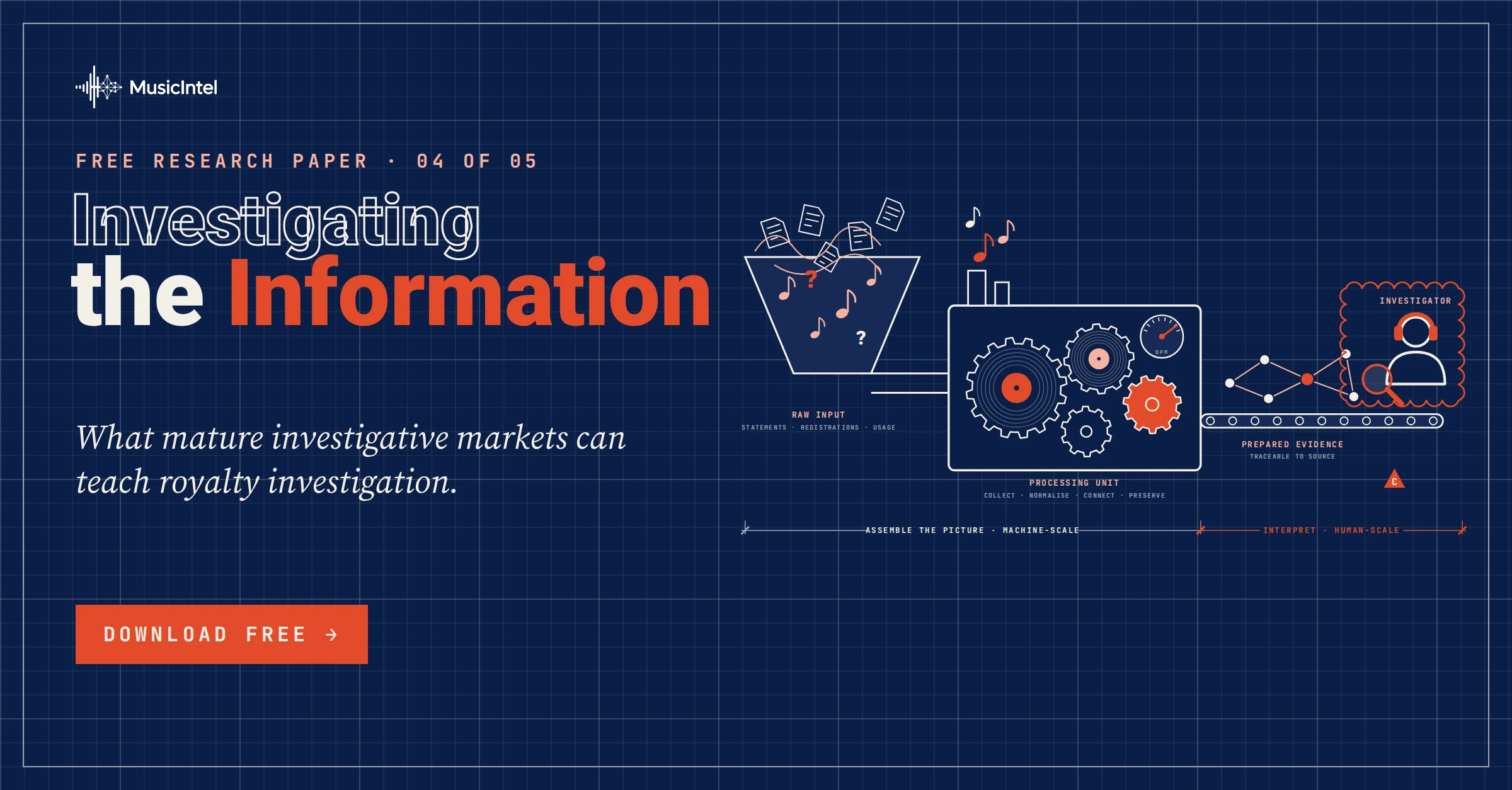
A royalty investigation is really two kinds of work. The first is assembling the evidential picture: finding records, comparing statements, reconciling names, matching works to recordings. The second is interpreting it. Historically, expensive specialists have done both, because that was the practical way to work. The result is an invisible gate: smaller or less certain claims can be uneconomic to investigate even when the concern is legitimate.
Music is not the first industry with too much data
Legal disclosure hit the same wall when business moved to email and the cloud. The answer was not more lawyers reading more documents. The court rules in England and Wales now ask parties to consider technology, keyword searches, duplicate identification, sampling and staged approaches. The Electronic Discovery Reference Model separated investigation into stages, with processing as the bridge between collecting the material and understanding it. When announcing disclosure reforms in July 2026, the Home Office noted that an average fraud case contains over four million documents.
Don’t clean away the interesting part
One lesson matters especially for music. If one source says a work is owned 50:50 and another says 75:25, normal data cleaning picks an answer. An investigator wants to know why two answers exist. The discrepancy itself may be the finding.
Why it matters
Investigating the Information is not about replacing the investigator. Technology can collect, process and connect the available information while preserving where every fact came from. The professional then spends their time on what it means. That is the Pattern Break: moving from assembling the investigation to investigating the information.
What’s inside the paper
- Why the economics of auditing create an invisible gate
- How legal disclosure and digital forensics learned to process before reviewing
- Why discrepancies should be preserved, not cleaned away
- Why the investigation needs a foundation of data before a layer of inference
Download the full paper, free
Get Investigating the Information as a designed PDF. It’s free: just enter your email address and we’ll send it straight to your inbox.
Download the paperAbout Music Intel
A company-level editorial statement.