
For most of the industry’s history, somebody had to say yes before music reached a mass audience. Studios, pressing plants, warehouses and shelf space all cost money, so a judgement was made before a record entered circulation.
Technology removed those costs one by one. The spare room became a studio. Digital distribution removed the pressing plant and the lorry. Streaming created a shelf that never fills up. The CMA found that the number of creators releasing music doubled from around 200,000 to around 400,000 between 2014 and 2020.
The shelf filled up rather quickly
Open distribution is a cultural good. It is also administratively demanding. UK Intellectual Property Office research published in 2026 found one streaming service reporting 47.8 million recordings in a year. Some 82% had no streaming activity at all, and only 0.0016% passed 100 million plays. Every one of those recordings still needs an identity.
Two perfectly good identifiers can still fail to meet
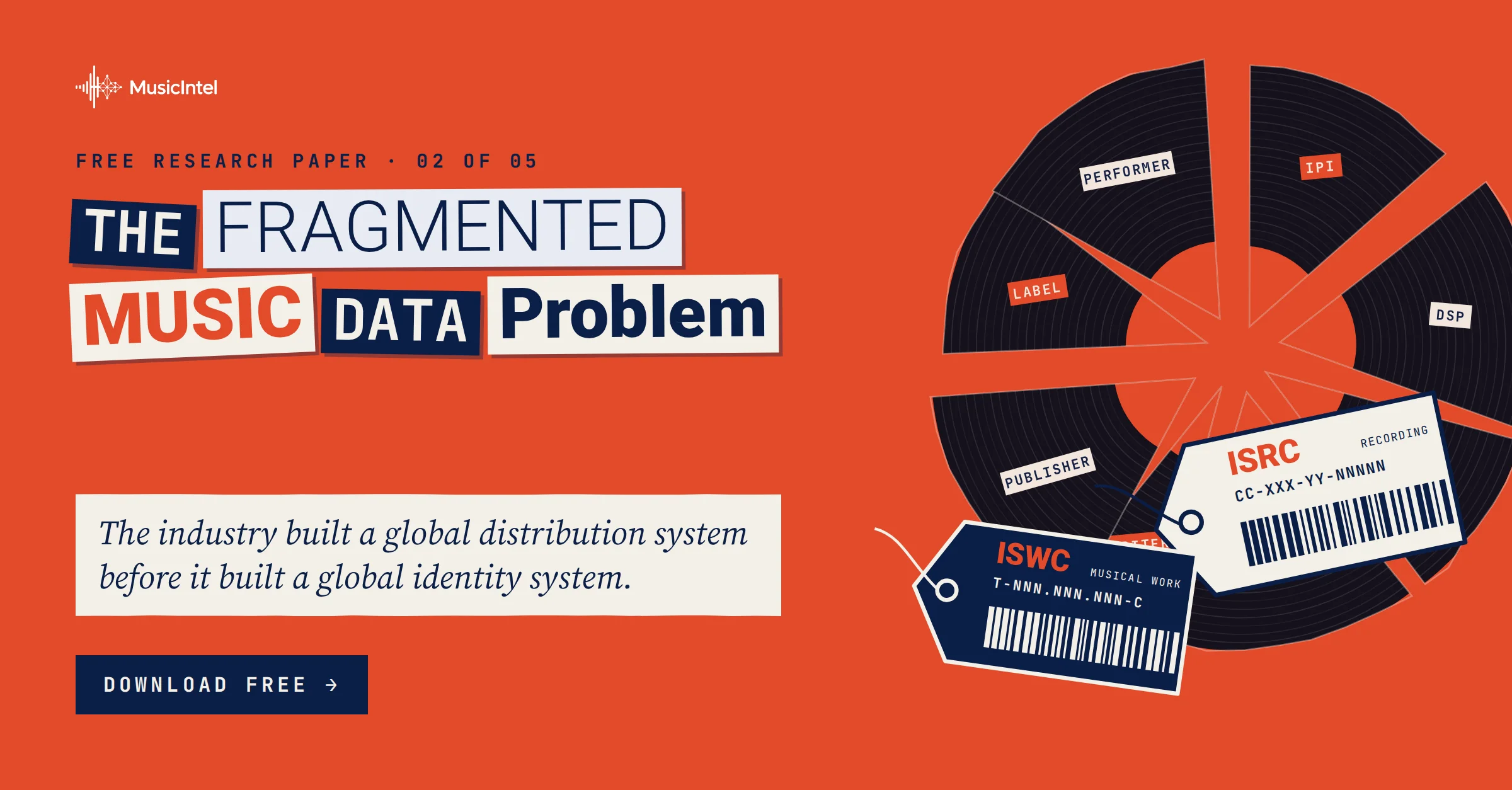
The industry is not short of identifiers. A recording has an ISRC, a musical work has an ISWC, writers have IPI numbers. The problem is the relationships between them. The same IPO research found that fewer than 0.1% of recordings arrived already mapped to an ISWC, and ISRC-to-ISWC matching ranged from 0% to 85% depending on the source.
Labels, publishers, societies, distributors and platforms each hold a legitimate piece of the picture. None of them holds the box lid. That is not incompetence. It is structure.
Why it matters
The Fragmented Music Data Problem argues that the industry is not starved of data. It is drowning in it, and every individual record can be correct while the complete picture remains fragmented. That raises the question at the heart of the next paper: if the information about one artist or work sits across many systems, how does anyone know they have found everything that matters?
What’s inside the paper
- How the gatekeepers disappeared, and what replaced them
- Why a standard is not the same as a register
- What the IPO’s 2026 metadata research actually found
- Why standards help databases talk, without making them one database
Download the full paper, free
Get The Fragmented Music Data Problem as a designed PDF. It’s free: just enter your email address and we’ll send it straight to your inbox.
Download the paperAbout Music Intel
A company-level editorial statement.